Happy Preschool Activities - Homeschooling - Bilingual Children - Parenting

Showing posts with label Math. Show all posts

Thursday, 16 November 2017

Jelly Beans Rainbow Science Experiment

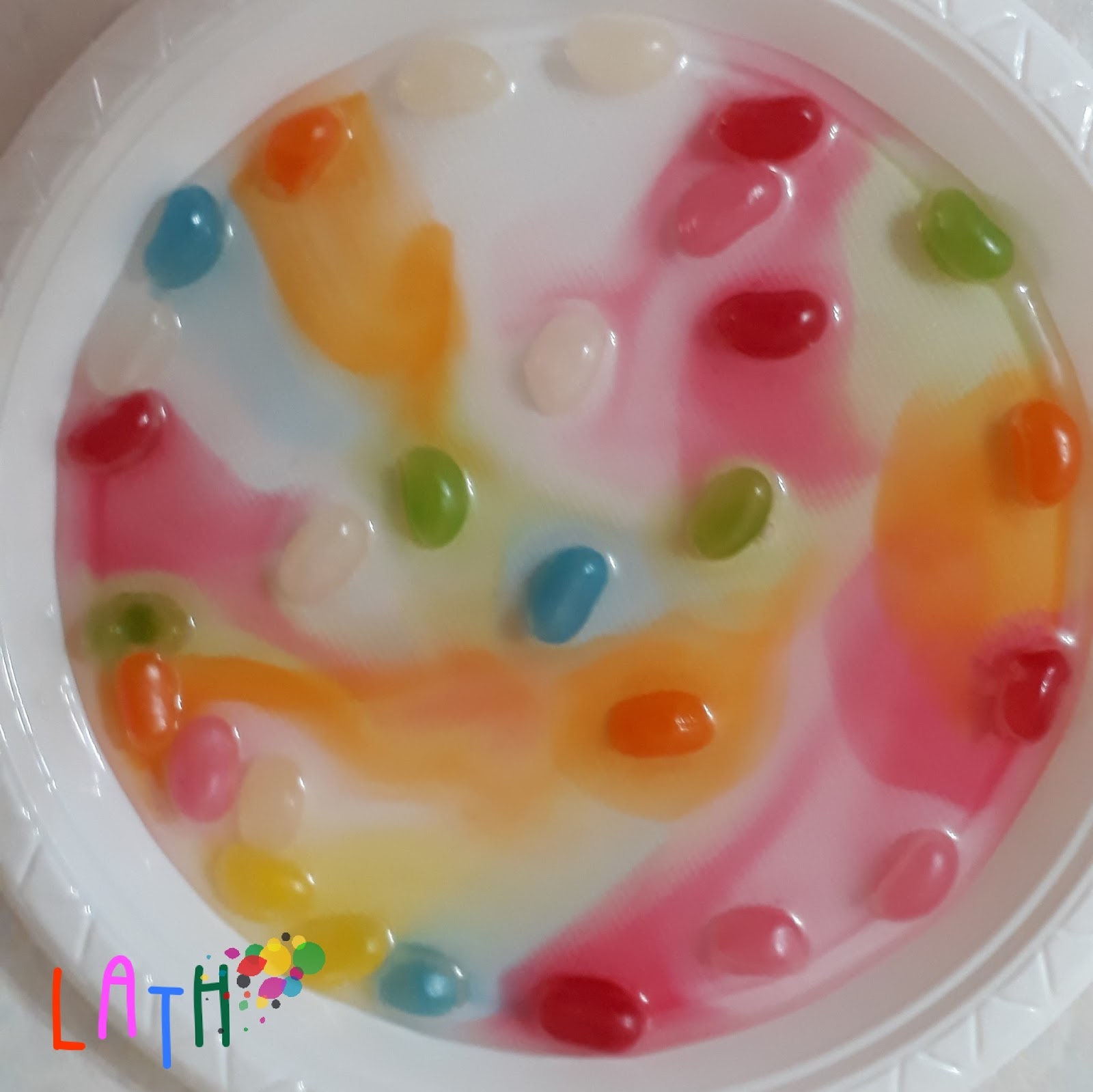
We have some jelly beans left from a party, so we decided to use them to make rainbows. This is an easy science experiment that you can do with your children. It takes less than five minutes to set up and they have a lot of fun exploring what happens with the jelly beans.

You will need

A bag of jelly bean
A white plate
A cup of warm water

What you do

  1. Arrange Jelly beans on the edge of the plate.
  2. Pour in some warm water.
  3. Wait and observe what happens.
  4. After the colours meet in the center, take the jelly beans out and observe what has happened to the jelly beans. 


What They Learn

  1. Children learn how to use and practise skills in the scientific method which is a techniques for investigating events, acquiring new knowledge, or correcting previous knowledge. They make observations, ask questions, make hypotheses, make an experiment and draw a conclusion. We didn't expect Mr Four to do all those steps in the scientific method but he actually did. He observed when we put jelly beans in the water, made a hypotheses about which colour would appear first, did the experiment, gathered the data and drew conclusions.
  2. Children learn about math in the experiment. There are patterns, colours, and lines. They observed how the colour travels, makes the shapes and creates patterns. Patterns can be found everywhere, it can help predict and can be used to solve problems. When children practise how to look for patterns, they also practise both mathematical and scientific skills. 
  3. We can help children extend their learning by asking open-ended questions. This can encourage meaningful answers using their own knowledge and feelings. During the experiment, we asked Mr Four what would happen if we put water on to the jelly beans? What colour would appear first? Or where did the colour come from? 
Let's watch the video how they did the experiment!


Share:

Saturday, 28 October 2017

Board Game With Preschool Children

A few months ago, we introduced Mr Four to play board games. We started with easy game, like snakes and ladders, then we moved on to harder game like monopoly. Because board games are rich in learning opportunity, the result of playing board games together is incredible. Mr Four has developed many skills in the past few months. Here are some examples. 

Following instructions. Children learn how to play a board game by following the instruction. They have to wait to their turn, roll the dice, pick a card, move the bit around the board, etc. There are rules in the games that they need to follow, the same as in real life. Board games allow children to experience rules, learn rules and negotiate with others when rules need to be modified.


Math skills. Counting the number on the dice, counting when they move their bits, adding numbers, reading numbers on the board, etc. Not every board game requires math, but a vast number of them do. Playing games will give children practice, improving their math skills and probable setting them up for STEM careers down the road.

Social and language skills. When we play games together we have to communicate with others, waiting, taking turns, and enjoying interaction with others. Board games offer opportunities for them to learn these important social skills. In real life, we are living in  a complex society. Board games can help children understand more about the world around them in much more simple ways and  within boundaries. 


Emotional skills. Some children play games very seriously. When Mr Four's piece fall down the snake, he feels very sad. When his piece goes up the ladder, he is very happy. Board games give a lot of opportunities for children to learn how to cope with these up and down feelings. Very young children, like Mr Four, sometime feel it is very important for them to win (and sometime we let them). Later on we try to play with "fair play", children can develop sense of fairness and it is ok if they don't win all the time. 

Family bonding time. What children want most is to be with you and spending time together. They want you to take pleasure in them, play with them, and listen to them. Board game is a perfect solution for this. We spend time together, we talk, we laugh and most of all we have fun!
It's very important to choose the age appropriate board game for children. Very young children tend to have short attention span and limited motor skills. Choose a game with simple rules, easy to understand and play and meet with their interest can give them hours of fun family time. 

What is your favorite board game? Ours is Peppa Pig Monopoly Junior. Let's see how we play it on the video. 

Share:

Monday, 14 August 2017

Spinning Top: Preschool Activity

Spinning top is a fun way to learn the concepts of motion, symmetry, and balance. Making their own spinning tops helps them to explore how does it work. What happened if you put the pencil to the side or place the cardboard on the top of the pencil. The process can help them develop basic scientific skills, start an hypothesis and test it out. Let's make one together. 

You will need

A Piece of Cardboard
A Circle Object to draw a circle with
A pencil
A pair of Scissors
Crayons to decorate


Let's do it

  1. Draw a circle on a cardboard by tracing the circle object. 
  2. Use the scissor to cut the circle out. Be careful the scissors are sharp.
  3. Decorate.
  4. Make a hole in the middle of the cardboard, put a pencil through the hole. 
  5. Spin!

What do they learn from the spinning top?

  1. Children can improve their fine motor skills. Twirling the stem of the top using the their fingers help them develop pincer grasp and dexterity. These skills can also benefit children with writing skill later. When they write, they need to manipulation and use the pencil with one hand.   
  2. Children can learn physical science by observing the top spin, or wobble. A spinning top is designed to spin rapidly with its rotational inertia. Don't worry, we haven't gone that far with Miss Two and Mr Four yet.
  3. Tops are designed to be symmetry, which is a sense of harmonious and beautiful proportion and balance. Symmetry can be found in many areas, mathematic, physics, chemistry, biology, architecture, visual arts, music, and much more. Learning about symmetry can help them understand 
  1. Making their own spinning tops helps them to explore how does it work. By providing them choices, they can try different way of making it. They can try making it big or small, using short/long/big/small pencil for the stem, or decorate it however they like. They can also try with different designs, what happened if they put the pencil to the side or place the cardboard on the top of the pencil. Then they can observe how their tops spin. Does it work? What are the colour of the tops look like? Mr Four found out that if he put the cardboard too high on the pencil, it didn't spin very well. The process can help them develop basic scientific skills, start a hypothesis and test it out.
Let's watch our children made spinning tops.


Share:

Sunday, 30 July 2017

Sorting by Colours
Activity for Toddlers

Miss Two and I are playing this sorting colour game for awhile. She loves the game. She can sit there and play for a long time. There are many many ways of sorting, sort by shape, sort by material, etc. Today we'd like to play sorting colours game. This activity is easy and only takes a few seconds to set up. You can use any colour objects to sort, For example, popsticks, plastic lids, pipe cleaner, small toys etc. Be careful when you choose the toys make sure they are not too small for little ones to choke on. We use wooden colour buttons for our fun. Let's get started.


You will need

Assorted colour wooden buttons.
A piece of paper
Crayons 


What you will do

  1. Draw and colour in circles with matched colour crayon and buttons. The little one can help.
  2. Sort the coloured buttons and match them to the correct colour areas.

When we started playing, Miss Two had no idea how this works. With her brothers help, he guided her how to do it for a couple minutes. After that she could do it all by herself. Sorting games are not only fun activity, children gain more benefits from the game much more than you thought.
  1. Sorting is a basic mathematical method. Sorting activities help them understand that things are alike and different as well as that they can belong and be organized into groups. 
  2. Sorting is something that helps children make sense of their world. They create order in a world that seems out of their control with basic math skills of matching, sorting and classifying. 
  3. Sorting can increase childrens literacy skill by naming the object, shape, colour, etc. Miss Two learnt about colour through this sorting game. 
  4. When playing sorting game together, they can work on communication skills
  5. Sorting help training the brain to create more organized thoughts and ways of retrieving information. This skill can be applied to other areas of their life in the future. 


Watch our children play Sorting by Colours


Share: